Feature: At the gateway to China's resistance, war scars remain as life blooms

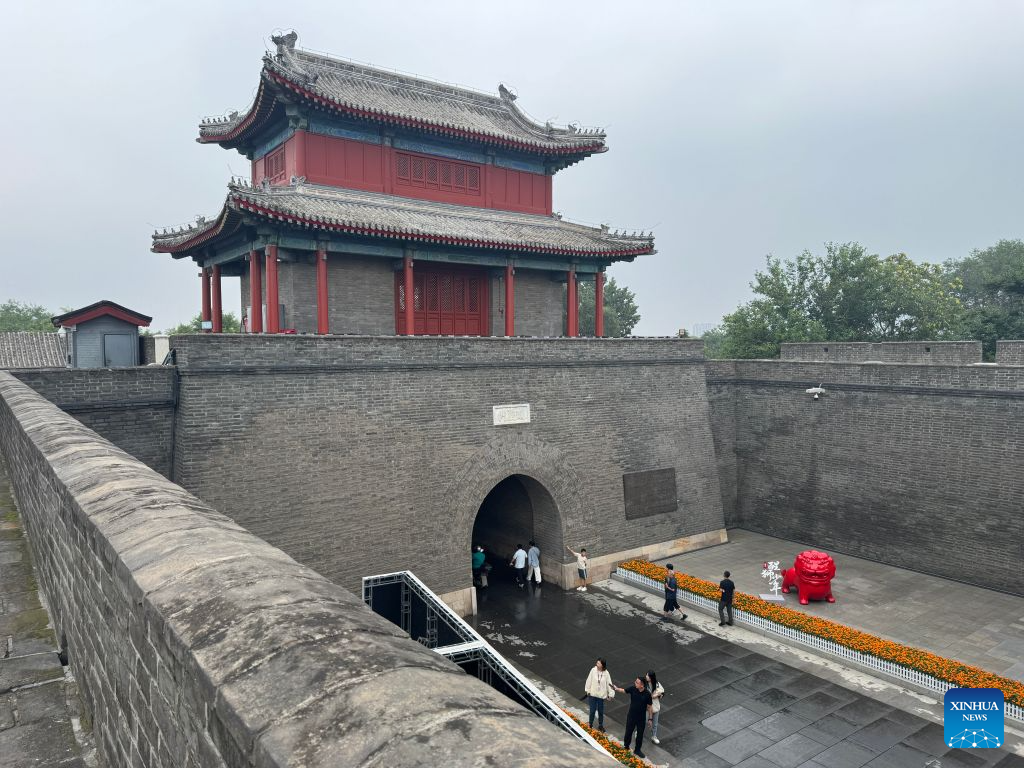
This photo taken on July 10, 2026 shows a view of Wanping, a fortress town, in Beijing, capital of China. (Xinhua/Yang Shenshen)
BEIJING, July 31 (Xinhua) -- At a site in Beijing where pockmarks from artillery shells still scar the ancient city walls, a new shop selling porcelain from China's porcelain capital Jingdezhen has opened its doors recently.
Instead of settling in a busy shopping mall or a hutong with a cultural vibe, China X, locally known as "Green Porcelain House," has chosen Wanping, a fortress town about 20 kilometers southwest of Tian'anmen Square. There, the ancient city walls still bear shell scars left from the Chinese People's War of Resistance Against Japanese Aggression.
At first glance, the pairing seems unusual: one represents Jingdezhen's ceramics heritage, while the other embodies the country's wartime memory. Yet, as ongoing renewal projects accentuate the town's historic features, a growing number of businesses are gravitating towards Wanping, enhancing its heritage attraction.
For shop owner Liu Siyang, however, the location choice went far beyond commercial considerations.
"I was born and raised at the west end of Lugou Bridge, right next to Wanping," said Liu. "I can still remember that when it rained, water would stream through the shell scars in the wall like little waterfalls. As a kid, I thought it was fun, without understanding what those scars truly signified."
The Lugou Bridge, also known as the Marco Polo Bridge, has stood for over 800 years and long served as a key gateway into Beijing.
It was on July 7, 1937, that Japanese troops attacked the Chinese garrison near the Lugou Bridge and began shelling the town, marking the escalation of Japan's aggression into a full-scale invasion and the start of China's nationwide resistance.
"We visited many places in Beijing before finalizing our shop location. When we came to Wanping, we felt this was where we belonged," said Liu. "The history here gives the town a special character, and porcelain is also part of Chinese history. We felt they belonged together."
Over the past 89 years, while the war-inflicted scars endure, the town has transformed. Across the street from Liu's porcelain shop stands the Museum of the War of Chinese People's Resistance Against Japanese Aggression, a symbol of this transformation.
"When I was little, the museum was very small," Liu said.
Following a 10-month expansion and renovation, the museum officially reopened in July 2025. Now housing 1,525 historical photos and 3,237 cultural relics, it stands as China's only large comprehensive memorial museum fully documenting the history of the war.
To preserve Wanping's historic integrity, the new exhibition hall was built underground beneath the adjacent Lion Dance Square, avoiding visual disruption to the ancient town landscape above.
History is also tangible beyond the exhibition halls. Along the ancient walls, shell scars left during the war have been carefully preserved rather than repaired, serving as silent memorials to a painful chapter.
A Beijing resident surnamed Yang, who visited Wanping for the first time, paused beside a shell scar to take photos. "I had seen pictures online, but standing here in person is completely different. You can really feel how close history is," he said. "We do not live in a peaceful age, but we are fortunate to live in a peaceful nation."
In recent years, local authorities have spearheaded comprehensive urban renewal efforts in Wanping, balancing historical conservation with high-quality development.
Since 2023, nearly 3,000 square meters of illegal structures attached to the city walls have been removed, reopening historic views that had long disappeared. Restrictive barriers around key heritage sites have also been replaced with visitor-friendly signposts designed to encourage cultural appreciation.
"We hope to make history easier to understand by bringing people closer to it," said Shen Jin, deputy general manager of Beijing Fengtai Culture and Tourism Group.
This sense of proximity drew Wang Deqiang and his 14-year-old daughter from Guangdong Province. "I've learned about the war in history class, and I want to see these relics with my own eyes," said the girl.
A similar motivation brought 80-year-old Xiong from Nanchang City in east China's Jiangxi Province. "The last time I came to Beijing was in 1992. This time, I wanted to take a closer look at Lugou Bridge," she said.
Wanping's renewal has also created opportunities for new businesses. The Lugou Bridge's iconic stone lions have been reinterpreted into popular cultural souvenirs, including refrigerator magnets and desk ornaments. Alongside the Green Porcelain House, the town now hosts 26 new stores, including cafés, restaurants, bookstores, souvenir stores and creative studios.
In December 2025, Liu Yanhong, a representative inheritor of the Linglong pillow-making technique, an intangible cultural heritage from Fengtai District in Beijing, opened a studio in Wanping. Inspired by Lugou Bridge, she designed a pillow featuring its stone lions and the famous moonlit scenery, with the ear hole of the pillow resembling the bridge's arch.
"At first, I only intended to commemorate Lugou Bridge, yet I never expected it would be so popular," said Liu, adding that integrating traditional handmade crafts into the historic town infuses it with unique charm.
According to Shen, instead of introducing chain stores or large commercial complexes, the town chose to attract cultural businesses that reflect its identity, creating spaces where visitors are willing to slow down and stay. In the first half of 2026, Wanping received about three million visitors.
Standing on the city wall today, visitors can see not only Lugou Bridge quietly stretching over the shimmering Yongding River, but also high-speed trains speeding by in the distance.
"With the land remaining safe and sound, Wanping continues to embrace new changes," said Shen. "Next year marks the 90th anniversary of the July 7th Incident. While preserving the town's historical heritage, we will introduce more cultural festivals, marathons and other events, and work to develop Wanping into a global memorial site for peace." ■
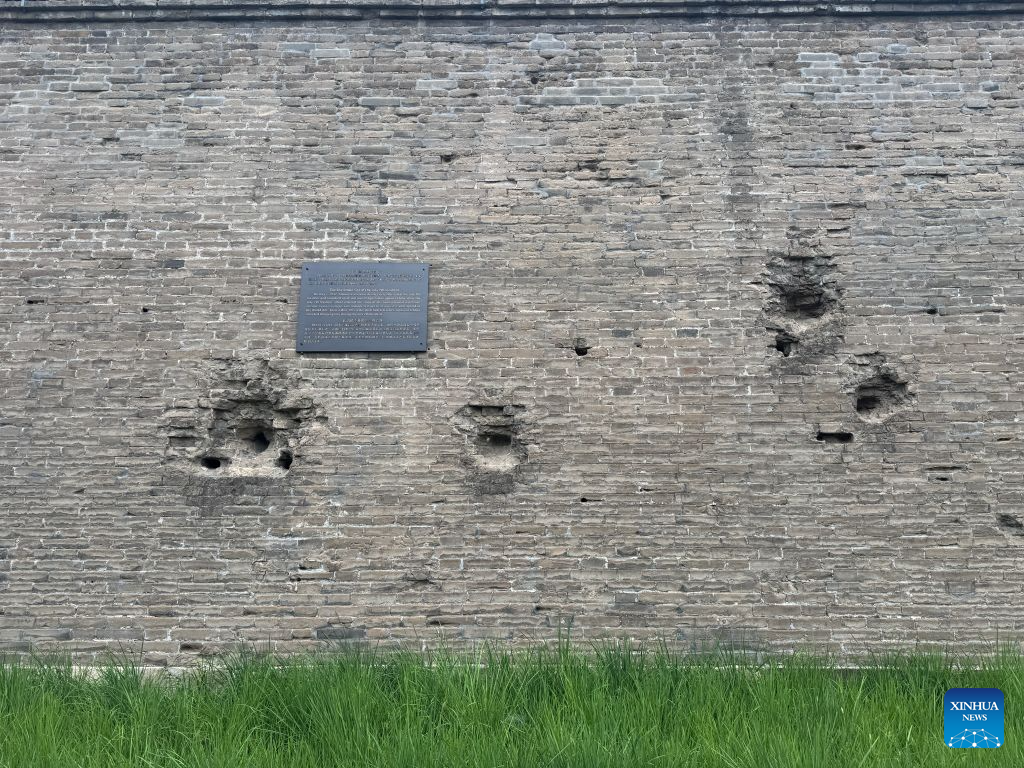
This photo taken on July 10, 2026 shows shell craters on the wall of Wanping, a fortress town, in Beijing, capital of China. (Xinhua/Yang Shenshen)


